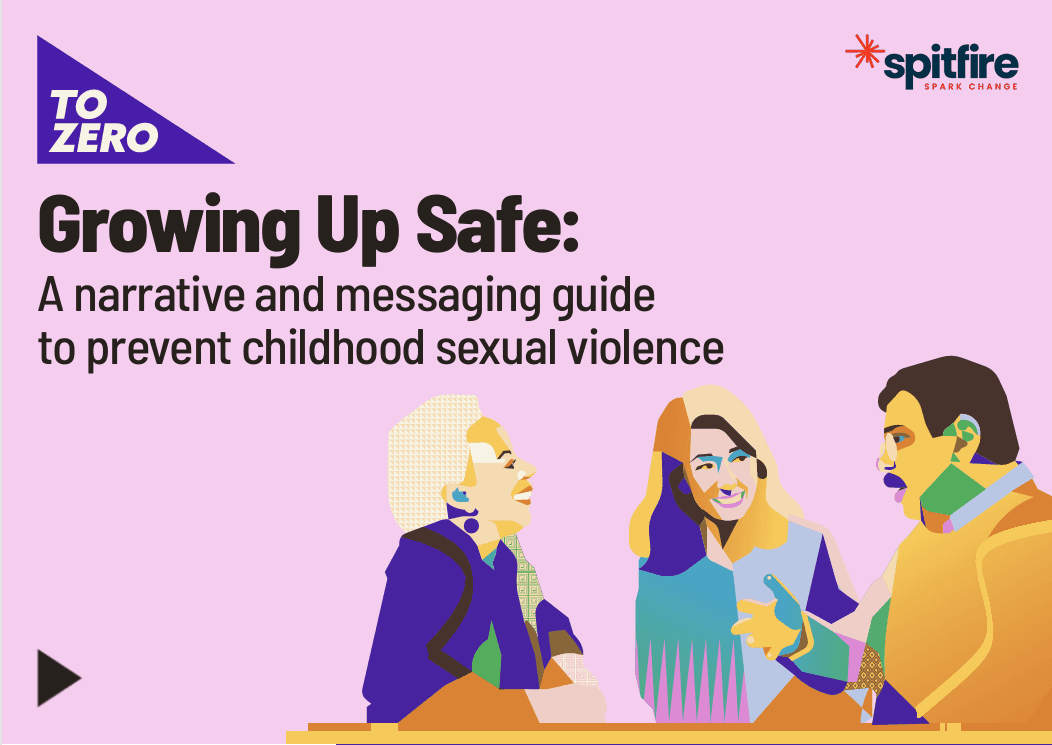
To Zero has launched Growing Up Safe, a narrative and messaging guide that supports advocates and practitioners in advancing a new narrative about childhood sexual violence — one that focuses on prevention, solutions, collective action, and hope.
Co-developed in partnership with Spitfire Strategies, the guide draws on analysis of media coverage across six continents and insights from survivors, advocates, and practitioners working to end childhood sexual violence worldwide.
Childhood sexual violence is preventable, and practical, scalable solutions exist. Yet dominant narratives continue to frame it as inevitable — often suggesting that punishment after harm has occurred is the only response.
When coverage defaults to fear and sensationalism, we fuel despair instead of catalyzing hope.
To challenge these assumptions, we must shift to aspirational narratives that emphasize prevention, highlight solutions, reduce stigma, and instill hope. Growing Up Safe offers a practical framework for doing exactly that — supporting organizations to showcase examples of prevention and evidence-based solutions, center survivor voices, and present a hopeful vision of a world where we all share responsibility for keeping children safe.
Why narrative change matters
The way we talk about childhood sexual violence shapes how people understand it — and what they believe is possible.
Too often, dominant narratives focus on:
▸Individual perpetrators, framed as "monsters" or "bad apples," limiting responses to crime and punishment
▸Systemic failures, told through stories of conspiracy, cover-ups, power, and profit
▸Punishment after harm, presented as the primary or only solution
These frames narrow how the issue is understood. They fuel stigma and silence, and make prevention feel out of reach. When childhood sexual violence is framed as inevitable, it becomes harder to recognize it as a preventable public health issue — and harder to mobilize collective action to address it.
Growing Up Safe offers a different path forward.
What’s inside this guide
▸ An overview of dominant frames present in media coverage and public discourse, and a clear vision for what aspirational narratives should achieve
▸ High-level messaging to help advance an affirmative narrative that emphasizes prevention, highlights solutions, and instills hope
▸ Practical, real-world examples showing how narrative change can be applied in organizational communications
▸ Suggested activities organizations can use to integrate narrative change into everyday work
▸ A curated set of resources to support deeper learning
Ready to get started?
▸ Download and explore the guide
▸ Use our social media toolkit to help spread the word
▸ Share it with colleagues, partners, and networks working on child safety and prevention
▸ Explore activities you can use to integrate narrative change into your everyday work
▸ Tell us how you're using it — we'd love to hear from you at info@to-zero.org.
Questions or feedback?
If this guide resonates with your work or sparks new ideas, we'd love to hear from you.
Contact us: info@to-zero.org